
At CHI 2025, researchers Nanna Inie, Jeanette Falk, and Raghavendra Selvan presented a timely and important study titled How CO2STLY Is CHI? The Carbon Footprint of Generative AI in HCI Research and What We Should Do About It. The paper evaluates the environmental impact of generative AI in human-computer interaction (HCI) research, based on an analysis of all 282 accepted papers from CHI 2024 that explicitly reported using generative AI.
The study offers valuable insights into how everyday research practices—especially prototyping and user testing with models like ChatGPT and Stable Diffusion—contribute to carbon emissions, and what the research community can do to reduce them.
📺 Watch the full video explanation here:
Estimating the Carbon Footprint of CHI 2024 Research
The analysis focused on 282 accepted CHI 2024 papers that explicitly referenced the use of generative models—ranging from open-source alternatives to commercial tools like ChatGPT and Stable Diffusion.
They categorized each paper's AI usage into five research phases: prototyping, evaluation, model training/fine-tuning, data generation, and inference. For each case, they estimated energy consumption by combining manual annotations with real energy measurements from local hardware. When key details—such as number of prompts or duration of system tests—were missing, the authors made conservative assumptions or reached out to authors directly for clarification.
Because cloud services like OpenAI’s APIs lack transparency around infrastructure and energy usage, the analysis focused primarily on local deployments of open models, offering a replicable and grounded estimate of AI’s carbon footprint in HCI research. The result: an estimated 10,700 to 10,900 kg of CO₂ equivalent emissions—comparable to driving 1,000 cars for over 100 kilometers each.
Key Findings
- Most common use: text-to-text generative models, primarily for prototyping or evaluating user-facing systems.
- Highest-impact phase: model training and fine-tuning, which—though rare—produced the largest emissions per paper.
- Average footprint: each prototype involving generative AI cost ~11 kg CO₂e to develop.
- Total impact of accepted papers: ~4,267 kg CO₂e.
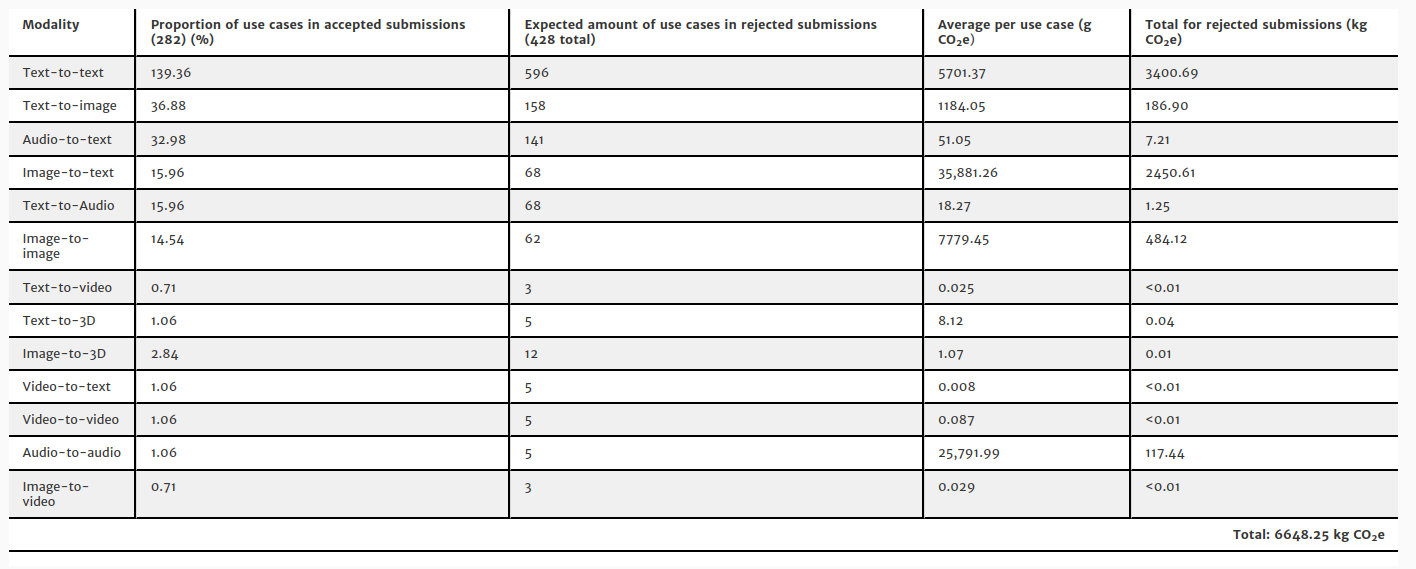
- Estimated impact of rejected submissions (10% assumed use rate): ~6,500 kg CO₂e.
- Total estimated emissions from CHI 2024 generative AI use: 10,700–10,900 kg CO₂e.
This analysis does not account for the energy spent during exploration, testing, or invisible background usage—meaning the real figure is likely much higher.
Proposed Mitigation Strategies
The researchers advocate for responsible AI research practices, highlighting several strategies to reduce the carbon impact of generative AI:
- Transparent reporting of emissions in papers, alongside other ethical disclosures.
Running models during low carbon-intensity hours or on greener grids, such as in Iceland. - Prefer open-source, task-specific models over large general-purpose ones when possible.
- Use minimal necessary data and promote reuse of datasets.
- Choose local or hybrid events to reduce the environmental cost of conference travel.
To support these efforts, they developed a user-friendly CO₂ calculator for non-ML research workflows:
🧮 https://www.hcico2st.com/
Alignment with SustainML Values
This study echoes SustainML’s mission to build a transparent and energy-conscious AI ecosystem. By quantifying the footprint of AI use and offering actionable steps for mitigation, this research sets a strong example of accountability in technology development and publication practices.
As generative AI becomes increasingly embedded in scientific work, initiatives like these remind us of the shared responsibility to assess and reduce our digital carbon footprint.
Citation:
Nanna Inie, Jeanette Falk, and Raghavendra Selvan. 2025. How CO2STLY Is CHI? The Carbon Footprint of Generative AI in HCI Research and What We Should Do About It. In Proceedings of the 2025 CHI Conference on Human Factors in Computing Systems (CHI '25). Association for Computing Machinery, New York, NY, USA, Article 206, 1–29. https://doi.org/10.1145/3706598.3714227
MORE INFORMATION ABOUT SUSTAINML:
If you have any questions, please get in touch with








 This project has received funding from the European Union’s Horizon Europe research and innovation programme under grant agreement No 101070408.