
As machine learning models continue to evolve, improving their performance without increasing computational cost remains a key challenge. A new research work titled “Latent Boost: Leveraging Latent Space Distance Metrics to Augment Classification Performance” proposes an innovative solution by making better use of the information already learned by models.
The approach introduces a method to enhance classification results by analyzing distances between data points in the model’s latent space. Instead of modifying the model architecture or increasing its size, this technique builds on existing representations to refine predictions and improve overall performance.
More details about the methodology and experimental evaluation can be found in the paper “Latent Boost: Leveraging Latent Space Distance Metrics to Augment Classification Performance” (Geißler et al., 2024, OpenReview).
Leveraging Latent Representations
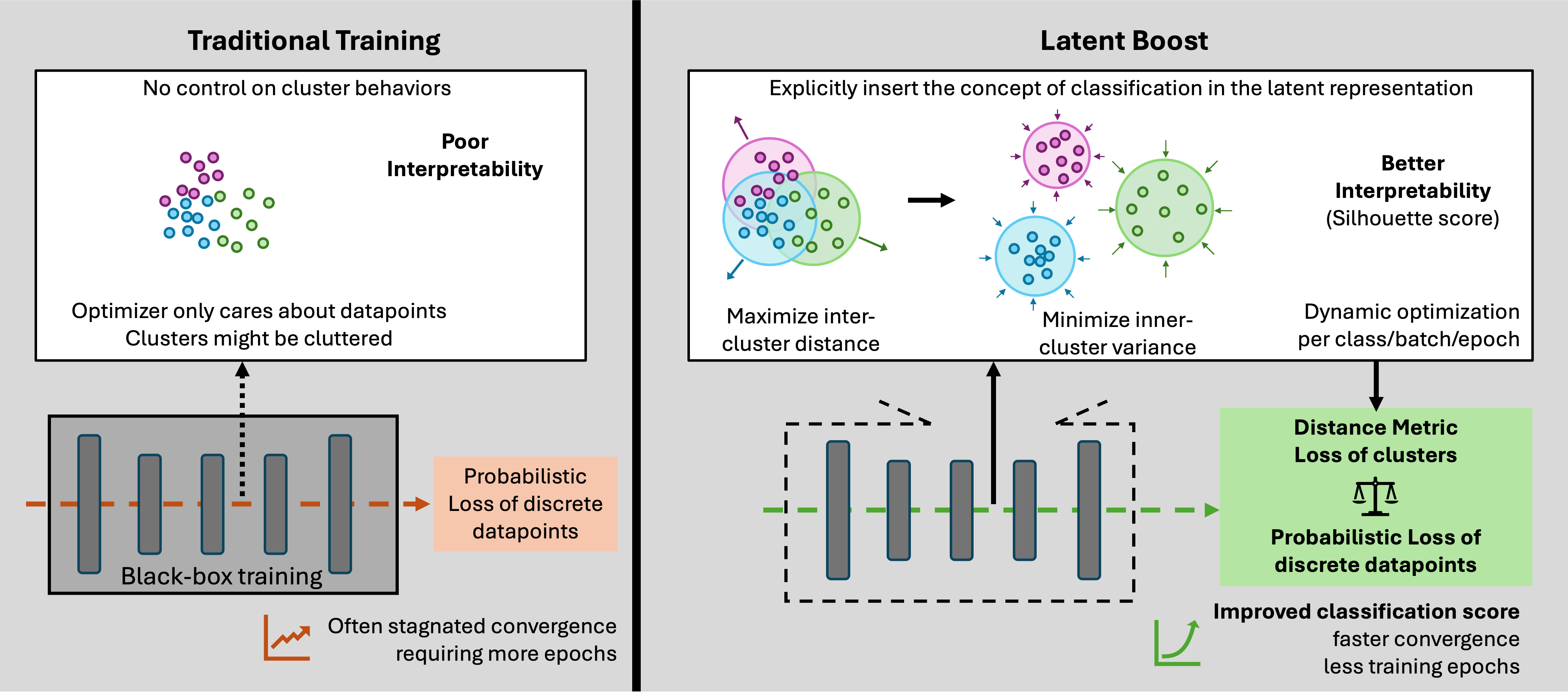
Modern machine learning models transform input data into latent representations—compact numerical encodings that capture meaningful features. These representations contain rich information about similarities and differences between data points, which can be exploited beyond standard classification outputs.
The Latent Boost approach takes advantage of this property by introducing distance-based metrics in the latent space. By analyzing how close or far apart different samples are, the method provides additional context that helps improve classification decisions.
Enhancing Performance Without Increasing Complexity
A key strength of this approach is that it improves classification accuracy without requiring additional training or more complex models. Instead of relying on larger architectures or more data, it enhances the decision-making process by reinterpreting existing information.
This makes the method particularly attractive for scenarios where computational resources are limited, or where efficiency is a priority. By avoiding costly modifications, Latent Boost provides a lightweight yet effective way to improve model performance.
A Step Towards More Efficient AI Systems
The results demonstrate that incorporating latent space distance metrics can lead to consistent improvements across classification tasks, highlighting the potential of this approach as a general enhancement technique.
From a broader perspective, this work reflects an important trend in AI: achieving better results not by scaling up models, but by using existing representations more intelligently. This aligns with the growing need to balance performance with efficiency.
Alignment with SustainML
This research is closely aligned with the goals of SustainML, which promotes the development of AI systems that are both powerful and resource-efficient. By improving model performance without increasing computational demands, approaches like Latent Boost contribute to more sustainable machine learning practices.
Optimizing how models use information is a key step toward reducing unnecessary computation and enabling scalable AI solutions. Techniques that enhance efficiency at inference time are especially relevant in real-world deployments, where resource constraints are often critical.
Looking Ahead
As AI continues to advance, methods that improve performance without additional cost will play an increasingly important role. Latent Boost demonstrates how deeper insights into model representations can unlock new opportunities for optimization.
By focusing on efficiency and intelligent use of existing data, this work contributes to the development of next-generation AI systems that are not only accurate, but also sustainable by design.








 This project has received funding from the European Union’s Horizon Europe research and innovation programme under grant agreement No 101070408.